June 6, 2014
A few deer go behind the garden nearly every morning. So far they have been happy munching on whatever is growing behind the fence. I found last year that if I put up a single wire electric fence and keep it energized for about one week I can just leave it off from then on. A friend mentioned that pigs and cows will keep on testing to see if an electric fence is on--I guess deer are smarter!
It is amazing how fast things are growing in the garden. I picked nearly a quart of sugar snap peas yesterday and a nice mess of spinach. I also dug up the rest of the early Pak Choi and cooked the nicer looking heads up with sesame oil, ginger and garlic (the majority was starting to get buggy and going to seed) . I then added a few shrimp --not a bad dinner actually.
Several years ago I dedicated my blog to photography--posting a new photograph every day. I decided this spring would be a good time to try to document one of my other hobbies--getting my hands dirty! Hopefully this blog will document some of the information I keep forgetting each year (when seeds germinate, etc.) and show some of my gardening tricks.
Empty nest
June 5, 2014
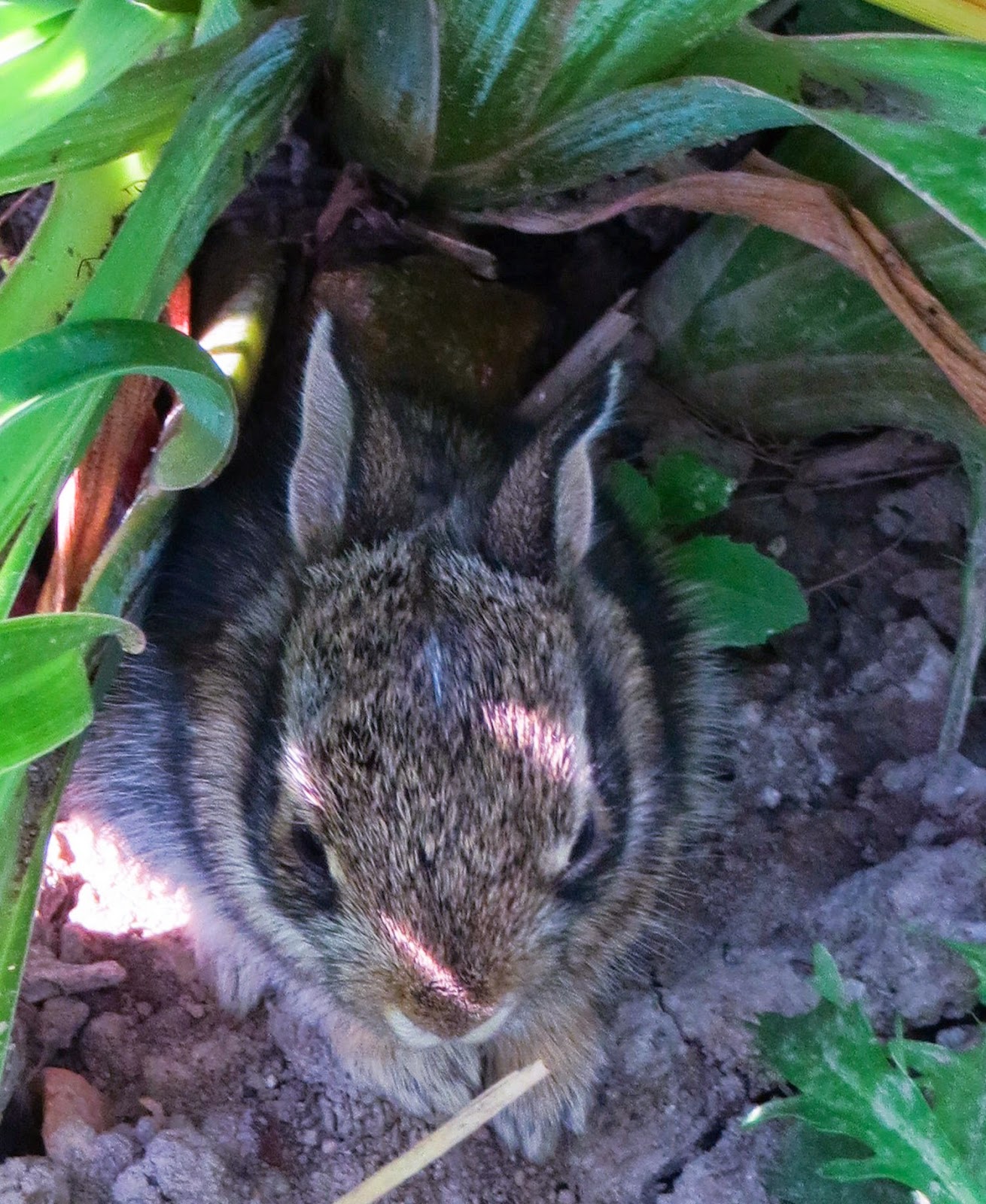
I started to water my flower bed when I noticed this:
I wonder how many baby rabbits were in there last week (they are now all in my garden).
I started to water my flower bed when I noticed this:
I wonder how many baby rabbits were in there last week (they are now all in my garden).
One of my favorites.
June 5, 2014
You would think that I would know the name of one of my favorite perennial flowers, but I don't! For a long time I called it a garden phlox, but after a bit of deep research (i.e. looking at Google Images), I am confident that it is Blue Flax (Linum perenne). The thing that is spectacular about the flower is the mass of blue flowers each morning, shown in the photo below.
The thing I love about the flax is that the individual flowers loose all of their petals each evening, growing a new set each morning!

As you can see from the seedling above, the leaves are very slender, almost needle-like. I have found that the plants are easy to transplant, and have several around the garden.
You would think that I would know the name of one of my favorite perennial flowers, but I don't! For a long time I called it a garden phlox, but after a bit of deep research (i.e. looking at Google Images), I am confident that it is Blue Flax (Linum perenne). The thing that is spectacular about the flower is the mass of blue flowers each morning, shown in the photo below.
The thing I love about the flax is that the individual flowers loose all of their petals each evening, growing a new set each morning!

As you can see from the seedling above, the leaves are very slender, almost needle-like. I have found that the plants are easy to transplant, and have several around the garden.
May update!
June 2, 2014
I can now sit back and enjoy the garden! I finished the final transplanting earlier today and managed to get the weeds and vines out of the fence row before the evening rains (3/4"). New additions include two tomato plants from my brother Hank (Indigo Rose and a Ananas Noire). He also gave me a pot with an "OCA oxalis species Andean tuber" (he grows weird stuff) which I transplanted into a larger container. I will have to find a location for its "special needs". I also transplanted a row of Swiss chard to complement the chard growing in the container garden.
Dinner yesterday evening was a pork stir-fry with zucchini, Swiss chard, Bok choi, sugar snap peas and fresh onions from the garden! I am certain that this is the earliest I have ever had zucchini (yes they were small, but tasty).

We will probably be eating crookneck by the weekend as well! If you look closely you can see the sugar snap peas. They are tasty stir-fried and just raw in salads (quite a few disappear from the vine while I am gardening!)
The eggplants are also doing well--the ichiban are already starting to bloom and the black beauty are just budding. I probably have too many in each pot, but they did so well last year that I decided to try again!
Finally, an update on the potato patch is in order! So far things look good. There have been several "sprouts" that have died (or at least disappeared), but as you can see from the photo below most of the shoots are looking healthy.
The first crop of bush beans are finally starting to form pods, so we should be eating fresh green beans from the garden in a week or so!
I can now sit back and enjoy the garden! I finished the final transplanting earlier today and managed to get the weeds and vines out of the fence row before the evening rains (3/4"). New additions include two tomato plants from my brother Hank (Indigo Rose and a Ananas Noire). He also gave me a pot with an "OCA oxalis species Andean tuber" (he grows weird stuff) which I transplanted into a larger container. I will have to find a location for its "special needs". I also transplanted a row of Swiss chard to complement the chard growing in the container garden.
Dinner yesterday evening was a pork stir-fry with zucchini, Swiss chard, Bok choi, sugar snap peas and fresh onions from the garden! I am certain that this is the earliest I have ever had zucchini (yes they were small, but tasty).

We will probably be eating crookneck by the weekend as well! If you look closely you can see the sugar snap peas. They are tasty stir-fried and just raw in salads (quite a few disappear from the vine while I am gardening!)
The eggplants are also doing well--the ichiban are already starting to bloom and the black beauty are just budding. I probably have too many in each pot, but they did so well last year that I decided to try again!
Finally, an update on the potato patch is in order! So far things look good. There have been several "sprouts" that have died (or at least disappeared), but as you can see from the photo below most of the shoots are looking healthy.
The first crop of bush beans are finally starting to form pods, so we should be eating fresh green beans from the garden in a week or so!
What rabbit fence?
May 31, 2014
I won't complain (too much). My neighbor had major portions of his garden disappear in one day from the rabbits! I had not been bothered since I learned from last years rabbit feeding frenzy that I needed a good rabbit fence if I was going to grow tasty plants (see earlier post--chicken fencing surrounds my entire garden). Unfortunately, I looked out and noticed a cute (?) visitor hiding in the flowers inside my rabbit fence early this morning.

I won't complain (too much). My neighbor had major portions of his garden disappear in one day from the rabbits! I had not been bothered since I learned from last years rabbit feeding frenzy that I needed a good rabbit fence if I was going to grow tasty plants (see earlier post--chicken fencing surrounds my entire garden). Unfortunately, I looked out and noticed a cute (?) visitor hiding in the flowers inside my rabbit fence early this morning.
I finally cornered him (her?) and reunited junior with the parent that was hiding behind the garden.

I assumed that Mr. Rabbit had come in through one of my two gates (I often leave them open when I am working in the garden), so it was no big deal. Later in the day I noticed that he/she had somehow gotten back in! I went in and before I was done I saw at least six different bunnies. I also found out that when they are that small they can just zip through the chicken fencing!
The only consolation is that they don't eat too much and will soon be too big to get through the holes. I did have to put my hardware cloth cages (1/4" holes) around the kohlrabi which they apparently love.
Nearly done!
May 23, 2014
The weather has been cooperating recently.
My picnic table is filled with plants ready to be transplanted. I still have 10 -15 peppers that I hope to find room for--I hate to throw anything away! Several of the clay pots will be transferred to my "ground stump" garden visible in the upper left. This is the area where the gas company took out my large sassafras tree and ground up the stump.
The above view is looking toward the house from the back of the garden. The white flowers are from the arugula that have gone to seed--I would pull them but Carolyn likes the flowers. I have a new row planted on the other side of the rubarb.
This view, taken from the gate at the front of the garden shows the progress of the peas (on the lattice). Several squashes transplanted today are in the foreground.
Finally, this is the "overflow" garden. You can see the progress of the potatoes (to the left).
With any luck, the rest of the garden will be out by early next week!
The weather has been cooperating recently.
My picnic table is filled with plants ready to be transplanted. I still have 10 -15 peppers that I hope to find room for--I hate to throw anything away! Several of the clay pots will be transferred to my "ground stump" garden visible in the upper left. This is the area where the gas company took out my large sassafras tree and ground up the stump.
The above view is looking toward the house from the back of the garden. The white flowers are from the arugula that have gone to seed--I would pull them but Carolyn likes the flowers. I have a new row planted on the other side of the rubarb.
This view, taken from the gate at the front of the garden shows the progress of the peas (on the lattice). Several squashes transplanted today are in the foreground.
Finally, this is the "overflow" garden. You can see the progress of the potatoes (to the left).
With any luck, the rest of the garden will be out by early next week!
More than just vegetables!
May 22, 2014
One of the things I am doing this year is adding a bit more color to the garden. I have a variety of annual flowers started in flats, and some have already been transplanted to the garden. One "star" this spring is my Clematis vine, shown below.
The bergamot (bee balm) transplanted earlier is doing well--hopefully my neighbors bees will appreciate all the work I am doing for them! I have tons of marigold plants started (the claim is that they repel bugs), and I will have nasturtiums throughout the garden.
One of the things I am doing this year is adding a bit more color to the garden. I have a variety of annual flowers started in flats, and some have already been transplanted to the garden. One "star" this spring is my Clematis vine, shown below.
The bergamot (bee balm) transplanted earlier is doing well--hopefully my neighbors bees will appreciate all the work I am doing for them! I have tons of marigold plants started (the claim is that they repel bugs), and I will have nasturtiums throughout the garden.
Garden update (May 10)
So far this has been an excellent month for the garden! It has only been slightly over a week since my last update, and much as happened. The first thing I will brag about is the potato patch. In the last update I mentioned that at least one shoot had appeared through the straw. Here is this mornings view:
It was raining this morning, but I could see probably 15 new shoots above the straw. Assuming something terrible does not happen, I should be getting a nice mess of potatoes this fall!
With the exception of the perennial flower bed in the Southeast end of the garden, all of the tilling has been done. I have also tilled some of the new ground where Duke removed the trees at the Northwest end, and have a nice crop of Pak Choi growing there.
The current layout for this years garden is:
I was able to finish up the fencing and installed two gates so that I don't have to climb over the chicken fence each time I need to get in. I have about 16 pepper plants of various varieties transplanted, and eight tomatoes! If you have trouble reading the map try left-clicking on it. On my computer this brings it up full size and you can pan around to see it.
I have a simple frame with chicken wire that hooks onto the two tomato cages to act as a gate. Note in the bottom center of the photograph the field tile buried with about 4 inches showing. This is an experiment to see if it makes watering the tomatoes easier. The tile goes down about 8 - 10 inches and rests on the compost/soil mixture that the tomatoes are planted in. The idea is to fill the tile with water and then let it slowly seep into the soil at the bottom. This is another trick based on what my granddad Patmore used to do. He would put a long row of tiles under his plants (he also used chicken manure and dug the ditch two feet deep!) and water the whole row from one end.
This photo also shows that the peas are rapidly growing, and (unfortunately) the arugula (in the background) has started going to seed. The blue flax on the left side of the photo is an amazing plant. Each morning it is completely filled with beautiful blue flowers, but toward the end of the day all of the petals fall off! If you look you can see that there is a progression of flower buds on each of the long stems. It is certainly one of my favorite garden flowers.
The above photo shows the flax in the foreground with my winter spinach (to the left) and kale to the right. In between are the broccoli plants that have now been out for about one week.
For once it looks like I will have a nice herb garden! I usually have trouble getting cilantro to germinate, and my basil is sometimes sporadic. This year I carefully kept the area where I planted the seed moist for the week after I sowed the seeds, and it looks like I may have had close to 100% germination.
The above photo shows my bush beans (Top Crop and Burgundy Bush). They were stared in the "seed starter" and transplanted slightly over a week ago. All are looking healthy so far, and a second crop has now been stared in the Yogurt cup seed starter (see photo below)
Finally, I want to show my "pot garden" (that will probably get more hits than anything else in my blog!). The seed starter is on the far end of the picnic table and the clay pots hold a variety of vegetables, including acorn squash, Swiss chard, eggplants, and various mints. In the background you can see the straw for the potato beds.
Nearly every thing is now planted. I will be putting out some more Swiss chard in the garden itself (now in flats), and the onion sets are all planted. One thing that I am planting in excess this year is zucchini! Last year I had a poor crop (damn those wasps that lay eggs on them that bore into the stem!). I am making a real effort to get a decent crop this year. In the photo below you can see my first squashes (zucchini in front, crookneck in back). You can also see where I have started my nasturtium flowers along the fence. I plan on having "nasty's" everywhere in the garden that I can (I love to eat them).
It was raining this morning, but I could see probably 15 new shoots above the straw. Assuming something terrible does not happen, I should be getting a nice mess of potatoes this fall!
With the exception of the perennial flower bed in the Southeast end of the garden, all of the tilling has been done. I have also tilled some of the new ground where Duke removed the trees at the Northwest end, and have a nice crop of Pak Choi growing there.
The current layout for this years garden is:
I have a simple frame with chicken wire that hooks onto the two tomato cages to act as a gate. Note in the bottom center of the photograph the field tile buried with about 4 inches showing. This is an experiment to see if it makes watering the tomatoes easier. The tile goes down about 8 - 10 inches and rests on the compost/soil mixture that the tomatoes are planted in. The idea is to fill the tile with water and then let it slowly seep into the soil at the bottom. This is another trick based on what my granddad Patmore used to do. He would put a long row of tiles under his plants (he also used chicken manure and dug the ditch two feet deep!) and water the whole row from one end.
This photo also shows that the peas are rapidly growing, and (unfortunately) the arugula (in the background) has started going to seed. The blue flax on the left side of the photo is an amazing plant. Each morning it is completely filled with beautiful blue flowers, but toward the end of the day all of the petals fall off! If you look you can see that there is a progression of flower buds on each of the long stems. It is certainly one of my favorite garden flowers.
The above photo shows the flax in the foreground with my winter spinach (to the left) and kale to the right. In between are the broccoli plants that have now been out for about one week.
For once it looks like I will have a nice herb garden! I usually have trouble getting cilantro to germinate, and my basil is sometimes sporadic. This year I carefully kept the area where I planted the seed moist for the week after I sowed the seeds, and it looks like I may have had close to 100% germination.
The above photo shows my bush beans (Top Crop and Burgundy Bush). They were stared in the "seed starter" and transplanted slightly over a week ago. All are looking healthy so far, and a second crop has now been stared in the Yogurt cup seed starter (see photo below)
Finally, I want to show my "pot garden" (that will probably get more hits than anything else in my blog!). The seed starter is on the far end of the picnic table and the clay pots hold a variety of vegetables, including acorn squash, Swiss chard, eggplants, and various mints. In the background you can see the straw for the potato beds.
Nearly every thing is now planted. I will be putting out some more Swiss chard in the garden itself (now in flats), and the onion sets are all planted. One thing that I am planting in excess this year is zucchini! Last year I had a poor crop (damn those wasps that lay eggs on them that bore into the stem!). I am making a real effort to get a decent crop this year. In the photo below you can see my first squashes (zucchini in front, crookneck in back). You can also see where I have started my nasturtium flowers along the fence. I plan on having "nasty's" everywhere in the garden that I can (I love to eat them).
Garden update (May 2, 2014)
It has been two weeks since I updated things, so (unfortunately?) I have a lot to report on. In general I have been lucky with the weather. It has been too wet and too cool to do much work in the garden the past week, so I have been busy moving starts from the flats to peat pots and larger containers. It looks like my timing on starting things was pretty good this year (luck, not skill). I have the chicken wire "anti-rabbit" fence installed around the entire garden now, and the electric fence is keeping the deer at bay. The tiller (actually a cultivator) is working well, and by first using a garden fork to break up the soil to a depth of about 10" it does a fantastic job. So far I have about 75% of the tilling done. I have been moving perennials and taking out some of the ones that did not make it through the winter.
1) We have potatoes! I was almost ready to give up and start digging through the straw to see if there was any sign of life in my potato patch, but when I checked this morning I see one glimmer of hope. I suppose this could be the only one to survive, but I bet not!
2) Not much remains of my garage greenhouse! I wheel the rack out each day the sun is out. As I said above, I have transplanted some of the starts, and all appear to be doing well. The photo here is my pepper collection for this years garden: California Wonder; Pimiento Cubane; New Mexico #6; miniature ornamental; yellow banana; Poblano; Red Mercury.
Probably 75% of what remains on the rack are annual flowers. I have actually put out quite a few nasturtiums and marigolds (with plenty more in reserve).
3) The peas are slowly making progress!

4) The herb patch in the garden has basil (left image) and cilantro (right image) germinated from seed directly planted about two weeks ago. Some "specialty" basil plants (Thai, spice bush) are still in the garage awaiting warmer weather.
5) Quite a few of my container plants are getting a good start (two types of eggplant, Swiss chard). I am also trying to revive some of the herbs that did not fare too well this past winter.
6) The rhubarb has really taken off (see April 5 entry) and it may be pie time this next week! The plants by the lattices in the background are acorn squash and yard long beans. I have my poles set for the Kentucky wonder pole beans
There is still a lot to do, but it looks like warm weather is returning this weekend. I will probably go ahead and start putting out tomatoes and peppers unless the long term weather forecast looks bad for next week.
I started transplanting from my seed starter last week, and have actually transplanted some of the veggies (and flowers) I started in flats. I only transplant about 1/3 to 1/2 of the plants that are ready in case Jack Frost decides to reappear! The following is a summary of where things stand:
1) We have potatoes! I was almost ready to give up and start digging through the straw to see if there was any sign of life in my potato patch, but when I checked this morning I see one glimmer of hope. I suppose this could be the only one to survive, but I bet not!
2) Not much remains of my garage greenhouse! I wheel the rack out each day the sun is out. As I said above, I have transplanted some of the starts, and all appear to be doing well. The photo here is my pepper collection for this years garden: California Wonder; Pimiento Cubane; New Mexico #6; miniature ornamental; yellow banana; Poblano; Red Mercury.
Probably 75% of what remains on the rack are annual flowers. I have actually put out quite a few nasturtiums and marigolds (with plenty more in reserve).
3) The peas are slowly making progress!

4) The herb patch in the garden has basil (left image) and cilantro (right image) germinated from seed directly planted about two weeks ago. Some "specialty" basil plants (Thai, spice bush) are still in the garage awaiting warmer weather.
5) Quite a few of my container plants are getting a good start (two types of eggplant, Swiss chard). I am also trying to revive some of the herbs that did not fare too well this past winter.
6) The rhubarb has really taken off (see April 5 entry) and it may be pie time this next week! The plants by the lattices in the background are acorn squash and yard long beans. I have my poles set for the Kentucky wonder pole beans
There is still a lot to do, but it looks like warm weather is returning this weekend. I will probably go ahead and start putting out tomatoes and peppers unless the long term weather forecast looks bad for next week.
Rainy day update
April 13, 2014
After several beautiful days of spring (temperatures about 70 F!) the rain and cold have returned. I did get a fair amount of work done over the weekend getting most of the fence "rabbit proofed" and some preliminary tilling done.
Unfortunately, my tiller died*, so I spent the morning taking it to the repair shop (ouch!). The kale and spinach shown in the photo are actually doing nicely and we have been eating both regularly. The arugula is actually starting to flower, so I put out another row, as well as a row of Bok Choi since both can certainly take the cold weather. I also cleaned up and started my "fountain" and put in a bunch of watercress that we picked up at the Bloomington Farmer's Market this last weekend.
The weather certainly looks bad for the coming week, and hard frosts are predicted for tonight and tomorrow night*. To be safe I brought my seed starter indoors. As you can see most of the beans and squashes have germinated and are doing nicely--all we lack is warm enough weather to transplant them!
*UPDATE (04/15/2014)
Woke up this AM with about 1/2 inch of snow on everything in the back yard :-(. The forecast for tonight is a low of 24, so I may lose most of my leaf veggies. That is the bad news--the good news is that J & S called and said they were able to get the tiller working!
When spring explodes!
Today was a perfect day! The temperature hit 70 in the afternoon and it looks like every spring flower decided it was time to bloom. While some of the crocus have been out for over a week, and the daffodils slightly longer, today everyone joined in.
The back yard suddenly became purple this afternoon.
The ftlowering cherry will probably be in full bloom by tomorrow.
The back yard suddenly became purple this afternoon.
The ftlowering cherry will probably be in full bloom by tomorrow.
Trillium and bloodroot are up.
Even these little guys decided today was the day.
On the gardening side, most of the seeds have germinated and the rabbit fence has been started (more later).
More signs of spring!
April 5, 2014
It was actually sunny today for the first time this week so I went out to check the mud and empty the rain gauge (4.1" since March 29). It has been a little over two weeks since I first saw the rhubarb starting to emerge from the ground. I decided to see how it was coming this morning and it certainly looks healthy!
I also checked to see if there was any other activity worth noting and, lo and behold!
It was actually sunny today for the first time this week so I went out to check the mud and empty the rain gauge (4.1" since March 29). It has been a little over two weeks since I first saw the rhubarb starting to emerge from the ground. I decided to see how it was coming this morning and it certainly looks healthy!
I also checked to see if there was any other activity worth noting and, lo and behold!
This is the first sign of the new asparagus bed I put in last spring. I have about eight plants of several different varieties, and I can see at least for or five spears coming through the mud.
Peas!
Each year I manage to plant peas (sugar snap) earlier than I should. My grandmother Huffman always said she planted them on Valentines day. Since we are 100 miles north, I assume this translates to about two weeks. This year the peas were the first thing to actually be planted in the garden--March 22nd. The ground was just barely dry enough to use my cultivator/tiller on, but it worked up OK. Below is the result as seen on April 04!
There are probably 6 - 10 that have sprouted in the last two days. I had to walk through the mud to get this photo. We have had 4.1" of rain so far this month (notice--that is only four days), so they may wash away!
Growing potatoes the modern way
For the past two years I have tried growing potatoes in my back yard garden with moderate degrees of success. I decided this year to approach the potato growing in a scientific way. What I am describing is actually not terribly scientific--for example I did not apply for external funding--but I am going to keep track of what I did and whether of not it worked.
Naturally, I started with a comprehensive literature search which allowed me to come to the following two conclusions:
The one thing which really stands out is that if you can successfully grow potatoes, it is necessary to write it up for a blog--either your own or someone else's. The blog entries also fall into two categories:
Being cheap I did not buy seed potatoes, so I may be introducing all kinds of blights etc. into the garden. My wife saved a half dozen bakers that had started to sprout and I had a basket of small potatoes from last year that had also started sprouting:
Following everyone's suggestion I cut the larger potatoes into segments and let them dry for two days on the picnic table.
Naturally, I started with a comprehensive literature search which allowed me to come to the following two conclusions:
- There are hundreds of ways to grow potatoes.
- There are hundreds of ways not to grow potatoes.
The one thing which really stands out is that if you can successfully grow potatoes, it is necessary to write it up for a blog--either your own or someone else's. The blog entries also fall into two categories:
- The successful ways to grow potatoes, which means you write up how you did it at the end of the season after you forget what all that you did; and
- The unsuccessful ways, which means you carefully describe what you did at the first of the planting season then never mention potatoes again.
Being cheap I did not buy seed potatoes, so I may be introducing all kinds of blights etc. into the garden. My wife saved a half dozen bakers that had started to sprout and I had a basket of small potatoes from last year that had also started sprouting:
Following everyone's suggestion I cut the larger potatoes into segments and let them dry for two days on the picnic table.
The next step was to prepare an area in the garden. I picked a spot by the back fence which was about 5' x 5' and tilled it (using my cultivator) to a depth of about 8" (as deep as it will go). A layer of relatively recent compost was then added, as well as some well composted leaves. After tilling this mixture I installed fence posts in each corner and used chicken wire to enclose the area.
I then split the remainder of the bale of hay into sections about 6" thick and placed them on the prepared surface.
Slots were then created in each of the sections and the potato started placed on a small amount of leaf compost in the slots and the crevices between the six sections. Following this the potato starts were all loosely covered with a layer of straw, and the bed thoroughly watered.
Now, if you find this is the last entry on potatoes on this blog you will know that none of this worked! I am actually confident that I will have at least some success, so I will keep you informed.
Subscribe to:
Posts (Atom)